
In every business, conflict is inevitable.
But as a leader, your responsibility is not to avoid conflict, but to ensure that the conflict within your team remains healthy and constructive.
This is when the clearing model comes in.
The clearing model is a communication tool designed to help teams navigate difficult conversations with clarity and empathy.
Whether you’re a manager or team member, mastering this model will give you a game plan for clearing the air, resolving conflict, and moving forward collaboratively.
Why Communication Skills Are Critical to Business Success
Before we explore the clearing model, it’s important to understand why communication is key in business.
A study from MIT tracked communication patterns across 30 different companies by giving employees badges that recorded their interactions. The results were eye-opening: communication was a stronger predictor of business success than individual intelligence or skill level.
This means you don’t have to be the smartest or the most talented person on the team to achieve success; if you excel at communication, you already have a significant advantage. Yet, despite this, many people never receive formal training on how to communicate effectively—especially when it comes to difficult conversations.
Think about it: in elementary school, middle school, high school, and even college, we rarely learn how to have hard conversations or resolve conflicts healthily. This lack of training often leads to conflict festering, misunderstandings growing, and resentment building in the workplace. The clearing model addresses exactly this gap by providing a structured approach to communication that anyone can learn and apply.
Introducing the Clearing Model: A Four-Step Framework for Healthy Conflict
The clearing model is designed to create a safe space where both parties can express themselves without fear of judgment or reprimand.
The goal is to “clear the air” and get everyone on the same page so that the relationship can move forward stronger than before.
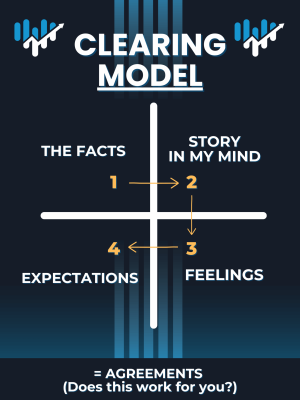
At its core, the model involves four clear steps:
- State the facts
- Share the story in your mind
- Express how it makes you feel
- Set your expectations moving forward
Each step plays a crucial role in ensuring the conversation remains productive and focused on resolution rather than blame. Let’s break down each step in detail.
Step 1: State the Facts
The first step is to calmly and objectively state the facts of the situation. This means describing what you saw or heard with your own eyes and ears—without adding any emotion, judgment, or bias. By sticking strictly to observable facts, you avoid accidentally accusing or blaming the other person, which can escalate conflict.
For example, instead of saying, “You were rude in the meeting,” you might say, “During the meeting yesterday, you interrupted me twice while I was speaking.” This factual statement sets a clear foundation for the conversation.

Step 2: Share the Story in Your Mind
Next, you share the “story” you have created in your mind based on the facts. This is where you explain your interpretation or perspective of what happened. Language here is key. Framing this as your story helps the other person understand that you are sharing your point of view, not making an absolute accusation.
We all interpret situations differently. Two people can witness the same event and come away with very different understandings. By stating your story, you open the door for the other person to share their perspective and clarify misunderstandings.
For instance, you might say, “When you interrupted me, it felt like you didn’t value my input,” rather than, “You don’t respect me.” This subtle difference makes the conversation less confrontational and more about mutual understanding.
Step 3: Share How It Makes You Feel
The third step involves expressing your emotions and feelings related to the situation. Vulnerability is a powerful tool in conflict resolution—sharing how something made you feel humanizes the conversation and encourages empathy.
However, it’s crucial to share your feelings without blaming the other person. Instead of saying, “You made me angry,” you might say, “I felt frustrated when this happened.” This helps keep the conversation focused on your experience rather than assigning fault.
Expressing emotions openly allows both parties to connect on a deeper level and often softens defensive reactions.
Step 4: Share Your Expectations Moving Forward
The final step is to clearly communicate what you expect to happen in the future. This step is about setting boundaries, clarifying needs, and making sure both parties understand what changes are necessary to improve the relationship and prevent similar conflicts.
By articulating your expectations, you create a roadmap for positive change and mutual respect. It might be something like, “In future meetings, I’d appreciate if you could let me finish my points before responding.”
Once one person shares their four-step clearing conversation, the other party should take their turn going through the same process. This ensures that both sides feel heard and understood, creating a balanced dialogue rather than a one-sided airing of grievances.
Implementing the clearing model successfully requires training and practice. Make sure to conduct a team-wide training that includes role-playing to help everyone get comfortable with the steps. This hands-on approach is essential for embedding the model into your company culture.
Leaders must lead by example, demonstrating vulnerability and openness during their own clearing conversations. When team members see leadership embracing this process, they’ll be more likely to adopt it themselves.
One tip we recommend is for team members to write out each step before having the conversation. Putting thoughts on paper helps clarify emotions and reduces the chance of the conversation becoming overly emotional or reactive.
Overcoming Challenges and Reaping the Benefits
Of course, implementing any new communication model isn’t without its challenges. It takes time, patience, and repetition to feel truly comfortable with the clearing model. Some team members may initially resist opening up or fear the vulnerability required. Others might rush the steps or revert to blaming language.
But the payoff is enormous. When teams commit to this process, they build a culture of trust and feedback where conflicts are addressed head-on rather than swept under the rug. This leads to stronger relationships, better collaboration, and an overall healthier work environment.
Most importantly, having these clearing conversations often leaves people feeling lighter and more connected, not more burdened. It closes the gap between knowing a difficult conversation needs to happen and actually having it, which is a critical step toward personal and professional growth.
Why You Should Start Using the Clearing Model Today
Clear, healthy communication is the backbone of any successful team. The clearing model provides a straightforward, actionable framework to transform conflict from a source of stress into an opportunity for growth.
By learning to state facts objectively, share your perspective, express feelings vulnerably, and set clear expectations, you create a safe space where honest dialogue thrives. This model not only resolves conflicts but also strengthens trust and collaboration within your team.

While it may take practice to master, the clearing model is well worth the effort. It equips you and your team with a game plan to get the elephant out of the room, clear the air, and move forward with clarity and respect.
If you are serious about building a winning team and fostering a positive workplace culture, adopting the clearing model is a crucial step. Start today, train your team, lead by example, and watch how healthy conflict transforms your business.
Remember, success doesn’t just come from talent or intelligence—it comes from how well you communicate and work together. The clearing model can help you unlock that potential.
For more insights on building strong teams and improving leadership skills, keep exploring proven communication strategies and never stop doing the work.